














The Ultimate Guide to Acoustic Panels: Science, Selection, and Setup
Introduction: The Hidden Impact of Sound
In our modern world, we are constantly bombarded by noise. From the hum of office electronics to the echo in a high-ceilinged living room, acoustic quality significantly affects our well-being, productivity, and comfort. This is where acoustic panels come into play. (Acoustic Slat Wall Panel Manufacturer China) No longer just a staple of recording studios, acoustic panels have become a critical component in architectural design, commercial real estate, and home improvement.
This guide provides a deep dive into the technical specifications, material science, and practical applications of acoustic panels, specifically focusing on PET felt and the trending wood slat designs. Whether you are an architect, a business owner, or a DIY enthusiast, understanding the "why" and "how" of acoustic treatment is the first step toward creating a better environment.
1. The Science of Sound Absorption
To choose the right acoustic panel, one must first understand how they work. Sound travels in waves. When these waves hit a hard surface like a drywall or concrete, they bounce back, creating echo and reverberation.
Absorption vs. Diffusion
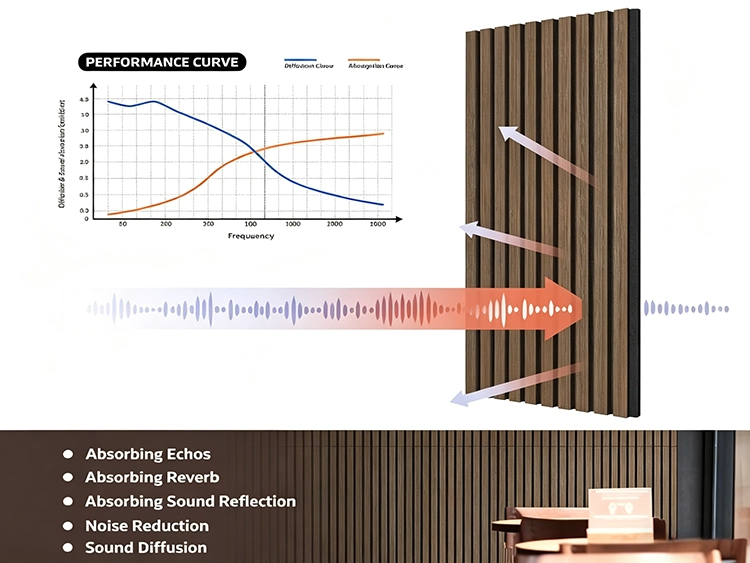
- Absorption: Converting sound energy into heat energy through friction within porous materials. This is what most panels do.
- Diffusion: Scattering sound waves in different directions to reduce concentrated echoes without removing sound energy entirely.
What is NRC (Noise Reduction Coefficient)?
The NRC is the primary metric for measuring how much sound a panel absorbs. It ranges from 0.0 (perfect reflection) to 1.0 (perfect absorption).
- NRC 0.4 - 0.6: Basic absorption, suitable for general background noise reduction.
- NRC 0.8 - 0.9: High-performance absorption, ideal for noisy offices or home theaters.
Pro Tip: Mounting panels with an air gap (using battens) can significantly increase their NRC rating, especially for low-frequency sounds.
2. Material Excellence: PET Felt and Wood Slats
The market has evolved from heavy fiberglass and foam toward more sustainable and aesthetically pleasing materials.
① PET Felt: The Modern Standard
Polyethylene Terephthalate (PET) felt is made from recycled plastic bottles. It is lightweight, durable, and non-allergenic.
- Durability: Unlike foam, PET doesn't crumble over time.
- Health: It is VOC-free (Volatile Organic Compounds) and contains no formaldehyde.
- Customization: It can be cut into intricate 3D shapes and dyed in hundreds of colors.
② Wood Slat Acoustic Panels (Akupanels)
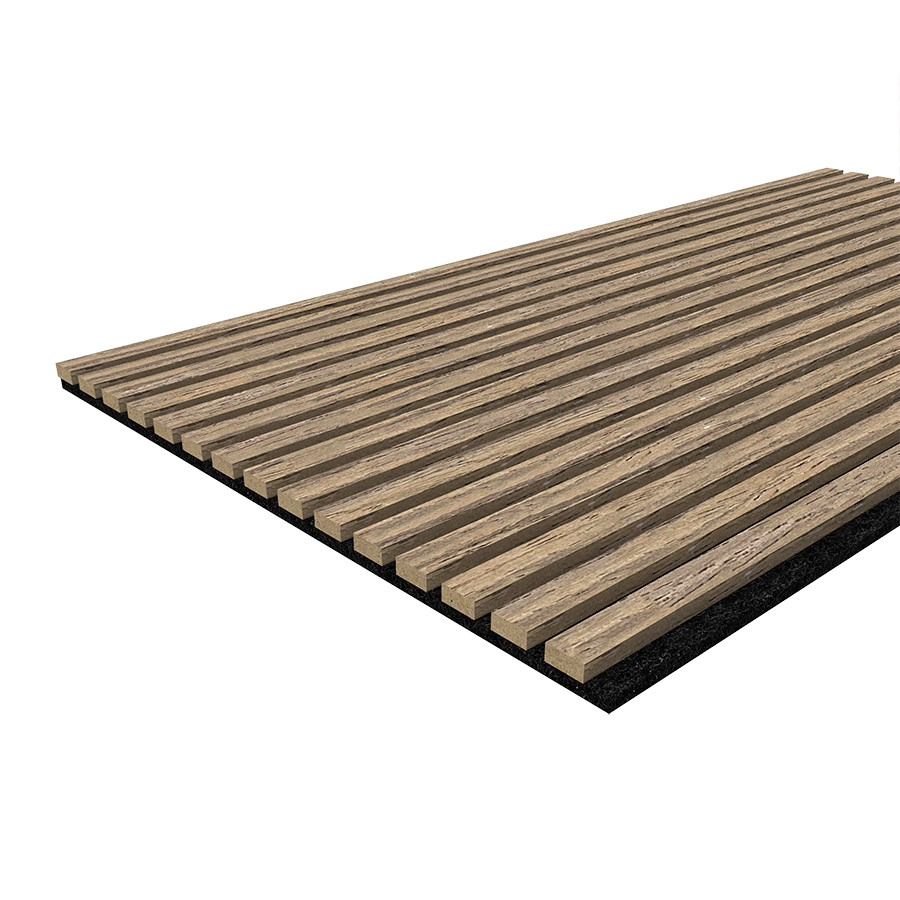
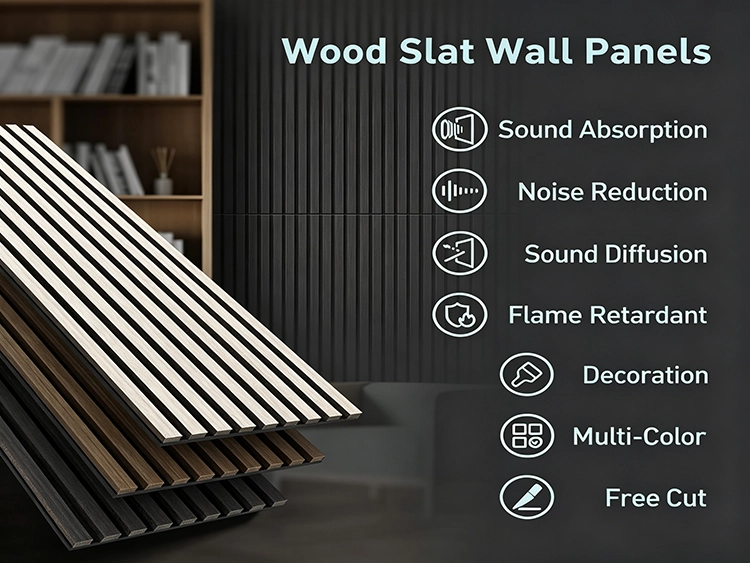
The current "darling" of interior design, wood slat panels combine a thick PET felt backing with vertical MDF or solid wood slats.
- Dual Function: The felt absorbs sound, while the slats provide a degree of diffusion and structural beauty.
- Veneer Finishes: Options like Natural Oak, Walnut, and Smoked Oak allow these panels to blend seamlessly into luxury interiors.
3. How to Calculate Panel Coverage
A common mistake is installing too few or too many panels. A general rule of thumb for effective sound treatment is:
- Home Office/Living Room: 20% - 25% of wall surface area.
- Commercial Office/Restaurant: 30% - 40% coverage.
- Home Theater/Studio: 50%+ coverage, including ceiling treatments.
The "Clap Test": Stand in the center of the room and clap. If you hear a sharp "zing" or long echo, you need more coverage on the primary reflection points (the walls directly opposite your sound source).
4. Installation: DIY vs. Professional
(Slat Wall Acoustic Panel Factory China) One of the reasons for the surge in acoustic panel popularity is the ease of installation.
① Method A: Construction Adhesive
Best for a permanent, seamless look.
- Clean the wall surface.
- Apply high-tack adhesive (like Liquid Nails) to the back of the panel.
- Press firmly and hold for 30 seconds.
② Method B: Black Drywall Screws
Best for wood slat panels.
- Screw directly through the black felt backing between the slats.
- The screw heads disappear into the felt, making them nearly invisible.
- This method allows for easy removal or relocation later.
③ Method C: Timber Battens (Enhanced Performance)
- Install 45mm timber battens on the wall first.
- Fill the gap with mineral wool or leave it as an air gap.
- Screw the panels onto the battens.
Result: Significant improvement in low-frequency sound absorption.
5. Maintenance and Longevity
( Wood Panel Acoustic Manufacturer China) Acoustic panels are a long-term investment.
- Cleaning: Use a vacuum with a brush attachment for dust. PET felt can be wiped with a damp cloth and mild soap for stains.
- Durability: PET panels are impact-resistant, making them ideal for high-traffic areas like hallways and schools.
6. Frequently Asked Questions (FAQ)
Q1: Can acoustic panels block sound from my neighbors
A1: This is the most common misconception. Acoustic panels are designed for absorption (improving sound inside the room), not insulation (blocking sound from entering or leaving). To block noise from neighbors, you need high-density materials like mass-loaded vinyl or double-layer drywall. However, panels can help by reducing the "bounce" of noise once it's in your room.
Q2: How many panels do I need?
A2: For a standard 12x12 room, covering 20-30% of the wall surface is usually sufficient for general speech clarity. For a home theater, you might want up to 50% coverage. Focus on the "first reflection points"—the spots on the wall where sound from your speakers hits first.
Q3: Are PET panels safe for nurseries or children's rooms?
A3: Absolutely. PET panels are non-toxic, VOC-free, and formaldehyde-free. Unlike old-school fiberglass panels, they don't shed tiny fibers that can irritate the lungs or skin. They are also soft and impact-resistant, making them "child-proof" for play areas.
Q4: Can I cut the panels myself?
A4: Yes. PET panels can be cut with a sharp heavy-duty utility knife and a straight edge. For wood slat panels, you will need a fine-toothed saw (like a circular saw or miter saw) to cut through the wood veneers without splintering.
Q5: Do they help with thermal insulation?
A5: Yes, to a degree. The high-density felt backing acts as an additional layer of insulation, helping to keep rooms warmer in the winter and cooler in the summer, which can lead to minor energy savings over time.
Understanding the technical side of acoustics allows you to move beyond "guesswork." By looking at NRC ratings, fire certifications, and material compositions, you ensure that your investment is not just aesthetically pleasing but scientifically effective. In an increasingly noisy world, the ability to control your environment is the ultimate superpower.